
The leaves are changing, and some big box stores have already skipped Halloween for their holiday displays. There is still time to review your tax strategy and avoid surprises, particularly with several provisions from last year’s One Big Beautiful Bill Act taking effect in 2026. The following figures are verified from the IRS website (www.IRS.gov) as of the original publication date of this article: October 22, 2026
Standard Deductions
The 2026 standard deduction is $16,100 for single filers, $32,200 for married couples filing jointly and $24,150 for heads of household. Compare these amounts to your expected itemized deductions.
Deductions and Credits with Income Limits
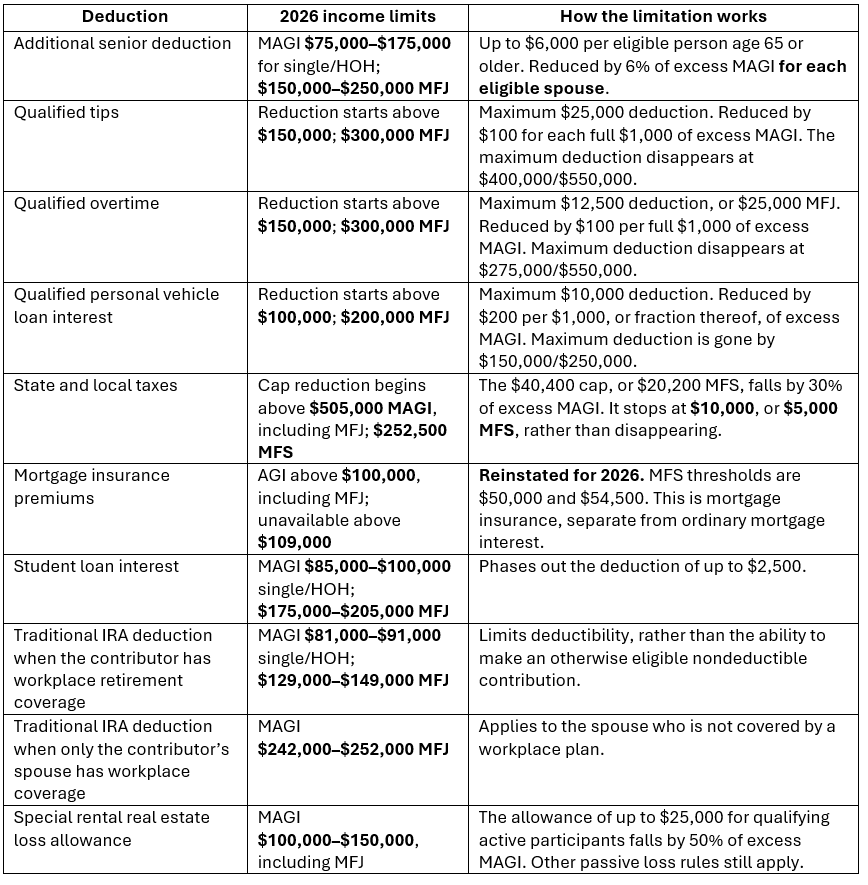
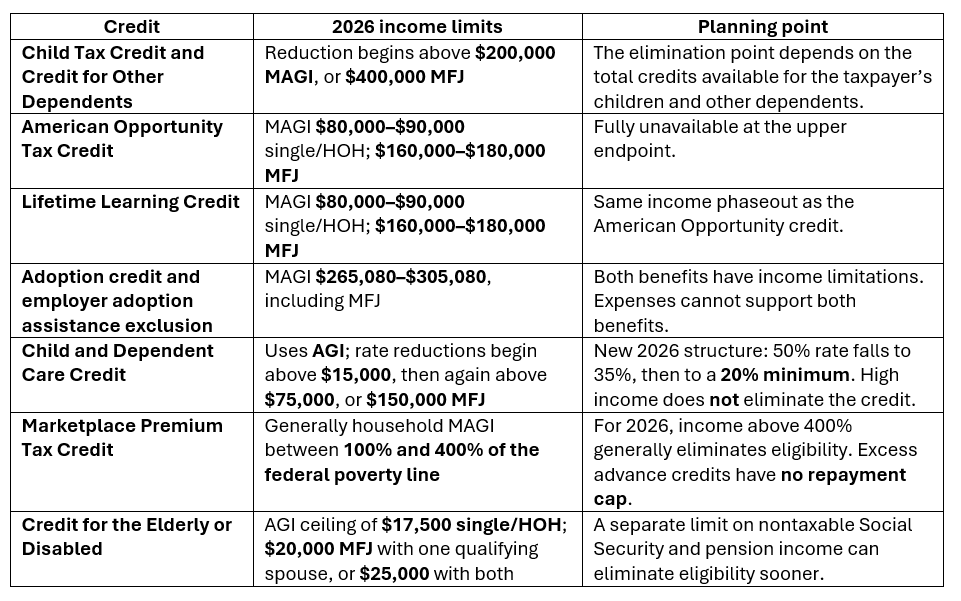
There are a number of deductions and credits that have phase-outs or reductions in relation to tax liability based on a taxpayer’s Modified Adjusted Gross Income (MAGI). These limitations are also sometimes based on filing status, such as Married-Filing-Jointly (MFJ), Single (S), Married-Filing-Separately (MFS), or Head-of-Household (HoH). Here are some examples of deductions, which can be very important for planning purposes:
Here are some examples of credits, which can be very important for planning purposes:
Coordinate Retirement Contributions and Withdrawals
Individuals considering changes to their 401(k) deferrals may wish to review their remaining pay periods and applicable plan provisions. The 2026 employee limit is $24,500, rising to $32,500 at age 50 or older, or $35,750 for those turning 60 through 63, if the plan permits. Elections generally must be made before the relevant pay is available.
Affected employees with more than $150,000 of 2025 Social Security wages from the sponsoring employer generally must make 2026 catch-up contributions as Roth contributions. Confirm the treatment with your plan administrator.
Eligible 2026 IRA and HSA contributions can generally be made through April 15, 2027; a filing extension does not extend that deadline. The combined traditional and Roth IRA limit is $7,500, or $8,600 at age 50 or older. Income and compensation rules still apply.
HSA limits are $4,400 for eligible self-only coverage or $8,750 for family coverage, plus $1,000 for eligible individuals age 55 or older. Employer contributions count toward these limits, and Medicare enrollment can restrict contributions.
Most ongoing required minimum distributions (RMDs) are due December 31. If you turn 73 in 2026, your first traditional IRA RMD may wait until April 1, 2027, but the second remains due December 31, 2027. Compare the tax effect of taking two in one year. Employer plans and inherited IRAs need a separate review.
Whether a Roth conversion is appropriate depends on an individual’s tax situation, financial circumstances, investment objectives and other considerations. Complete a planned direct 2026 conversion by December 31 and calculate its effect on taxes and income-based benefits. An RMD cannot be converted.
Plan Charitable Giving and Family Gifts
Charitable giving deserves a closer look this year. Taxpayers taking the standard deduction can deduct up to $1,000 of qualifying cash gifts, or $2,000 on a joint return; donor-advised fund contributions do not qualify. Itemizers face a new 0.5% AGI floor. Consider whether concentrating planned gifts in one year would affect the amount of available charitable deduction, and complete 2026 gifts by December 31.
Those aged 70 1/2 or older may make qualified charitable distributions (QCDs) of up to $111,000 per person in 2026, directly from eligible IRAs to eligible charities. A qualifying QCD can satisfy an RMD while keeping the amount out of taxable income, without a separate charitable deduction.
Complete intended 2026 family gifts by December 31. The annual federal exclusion remains $19,000 per donor, per recipient for qualifying gifts; the estate and gift basic exclusion is $15 million per person.
Give Business Planning Its Own Review
Business owners may wish to review a current profit and loss statement and balance sheet when evaluating potential year-end purchases. Eligible equipment acquired and placed in service in 2026 may qualify for 100% bonus depreciation. The Section 179 maximum is $2,560,000, subject to purchase, income, eligibility requirements and other limits. Equipment must be ready and available for use by year end.
Eligible domestic research costs may be deducted currently, and the deduction of up to 20% of qualified business income is now permanent. Coordinate retirement contributions with the qualified business income calculation.
SEP employer contributions can reach $72,000, subject to compensation and eligibility rules, and generally may be funded by the business return deadline, including a timely extension. Other plan elections and employee deferrals may require earlier action.
Businesses may wish to review Forms W-9 and vendor payments in preparation for applicable information-reporting requirements. The general Form 1099-NEC reporting threshold for 2026 service payments increased from $600 to $2,000. Employers should also confirm required tips and overtime reporting.
Compare 2026 and 2027 results before changing expense or collection timing, considering accounting methods and state rules.
Check Benefits and Investment Decisions
During open enrollment, consider reviewing health coverage and flexible spending account balances. The dependent care assistance exclusion increased to $7,500 in 2026, or $3,750 if married filing separately, if your employer’s plan permits it.
Individuals receiving Marketplace premium tax credits should consider reviewing their current income estimate. For 2026, eligibility generally ends above 400% of the federal poverty line, and repayment caps for excess advance credits are gone. Business profit, investment gains or a Roth conversion can create a substantial repayment.
Review investment gains and losses before December 31. Investment decisions should not be made solely for tax purposes, but they can affect tax liabilities in ways that will cause tax liability to fluctuate in varying degrees year-over-year. Investors should consider all investment objectives, risk, costs, and individual circumstances when making decisions.
Confirm Payments and the Remaining Deadlines
Meeting an applicable safe harbor may help taxpayers avoid certain estimated-tax underpayment penalties, subject to applicable requirements. Individual safe harbors generally require timely payments and withholding covering the smaller of 90% of 2026 tax or 100% of 2025 tax. Use 110% of prior-year tax if 2025 AGI exceeded $150,000, or $75,000 if married filing separately. The prior return must cover a full year.
Additional withholding before year end may help cover a shortfall because it is generally treated as paid throughout the year. A late estimated payment does not automatically erase an earlier underpayment. A safe harbor can prevent penalties and interest while leaving tax due at filing.
Allow extra processing time for custodians, payroll providers and plan administrators.
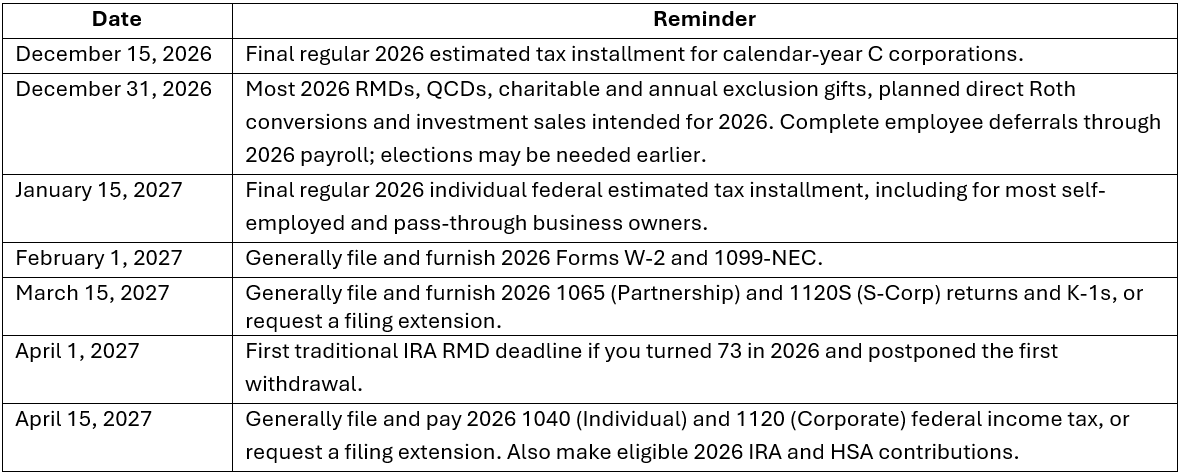
Some upcoming general federal dates and deadlines to keep in mind are as follows, and are subject to individual circumstances, weekends/holidays, state requirements or subsequent IRS guidance:
In Conclusion
It is important to know that there are myriad rules in the tax code, and the team at Baldwin is ready to help you plan, answer questions, and understand how the tax code affects your personal tax plan.
The opinions expressed in this Commentary are those of Baldwin Investment Management, LLC. These views are subject to change at any time based on market and other conditions, and no forecasts can be guaranteed. The reported numbers enclosed are derived from sources believed to be reliable. However, we cannot guarantee their accuracy. Past performance does not guarantee future results. This commentary is for information purposes only. Nothing herein should be construed as investment advice or a recommendation to buy or sell any security. Forward-looking statements are based on current assumptions and are subject to change. A current copy of our ADV Part 2A & Privacy Policy is available upon request or at www.baldwinmgt.com/disclosures.
Sources: www.IRS.gov

Benjamin Meck, CPA, CFP® | Deputy Managing Director of Accounting Services
Benjamin joined Baldwin Family Office in 2023 after spending 8 years gaining experience in corporate, cost, construction, and property accounting. He holds a B.S.B.A in both Accounting and Finance from Bloomsburg University of Pennsylvania. He earned the CPA designation in 2022. He is a member of the Pennsylvania Institute of Certified Public Accountants, the National Association of Tax Professionals, and the Construction Financial Management Association.